
GBCA Members | Sustainability in the Sydney Building and Construction Industry


PumperDump is proud to be acknowledged becoming a member of the Green Building Council of Australia.

Our membership demonstrates our commitment to “the sustainable transformation of the built environment”. PumperDump’s core vision aligns with the GBCA in being able to proudly and ethically recycle 100% of all concrete waste and washout water resulting from construction activity, providing a sustainable and zero emissions future for our construction clients as well as for our industry.


This is an association with Australia’s sustainability leaders who are committed to:
  • Supporting the creation of buildings and other infrastructure that are environmentally responsible and result in sustainable, efficient, profitable and healthy places for communities to live and work in.
  • Fostering a strong bind amongst peers and associates in the building, design, construction, and sustainable operations industries;
  • Encouraging the development and promotion of sustainable communities and environmentally responsible building practices;
  • Leading market transformation in sustainability and campaigning for the wider recognition of environmentally responsible buildings and practices;
  • Supporting and encouraging educational and research programs aimed at raising the knowledge and skill base of green building practitioners;
  • Actively aligning with relevant publicly funded research to the practice/market requirements for innovation and development in green building implementation;
  • Participating in public debate on environmental issues within the building industry;
  • Supporting the campaigning and soliciting of funds to be applied towards the GBCA’s objectives;
  • Acting with integrity, due care, and in a manner that upholds the reputation of the works and objectives of the GBCA and Green Star rating tools, its officers and employees.
We are pleased to be joining some of the industry’s most influential players on the Green Building Council of Australia register. Below are some of PumperDump’s clients who too are accredited members of the GBCA. Read below some of the exciting developments these companies are currently involved in around Sydney.

ADCO Constructions
With a national presence across Australia for nearly 50 years, ADCO Construction is one of the oldest and most established construction companies in Australia. A company committed to delivering quality to their clients, ADCO Constructions has managed to build a legacy amongst the industry – with over 3500 projects, valued in excess of $14 billion. Amongst their roaring success, ADCO is also a proud member of the Green Building Council of Australia and remain committed to the success and increased adoption of sustainable construction practices. Some of ADCO Construction’s recent Sydney projects include being the building partner for the next Property Industry Foundation (PIF) House in Sydney, which will give five homeless youth a safe and secure place to live.

Hutchinson Builders
Established in 1912, Hutchinson Builders is one of Australia’s largest privately-owned building and construction companies. Hutchinson Builders have transformed into a dynamic and diverse construction company, delivering sophisticated projects across a comprehensive portfolio. With 300+ projects built annually, “Hutchies” was able to generate a $2.87 billion turnover in 2020 alone. As members of the Green Building Council of Australia, they are leading the way in developing sustainable approaches and building services systems which address the key environmental criteria associated within the construction industry. With one in every 12 Green Star Rated building in Australia been built by Hutchinson Builders, they have delivered more than $2 billion Green Star Rated buildings. Hutchinson Builders have recently undertaken the first phase of truss installation for the Castle Residence project, working alongside United Development Sydney, bringing together high-end apartments with five-star luxury hotel services and amenities.

Richard Crookes Constructions
A private, family owned construction company that has been delivering projects as promised; safely and to the highest quality throughout NSW and ACT since 1976. Richard Crookes Constructions remains committed to continually improving the integration of sustainability into their working environment and business processes. RCC aims to portray a proactive role in contributing towards achieving sustainability where they have an influence in the delivery of construction. Whilst being members of the Green Building Council of Australia, Richard Crookes Constructions remains committed to following key objectives with regards to; Sustainable construction, reduced operational resources and sustainable reuse at end of service life. Current projects included the redevelopment of the Wyong Hospital in Hamlyn Terrace, NSW.

PumperDump looks forward to pushing the sustainability agenda for all our projects for the benefit of our clients and the community.

Want to know more, then get in touch

#PumperDumpSolution #Construction #ConstructionIndustry #ConcreteRecycling #ContructionWaste #ConcreteSolutions #ConcreteManagement #ConcretePump #ConcreteWashout #ConcreteWasteManagement #C&DWaste #CircularEconomy #GreenBuilding #Pollution #NSW #NSWGovernment #Sustainability #Sydney #SydneyConstruction


Share this article

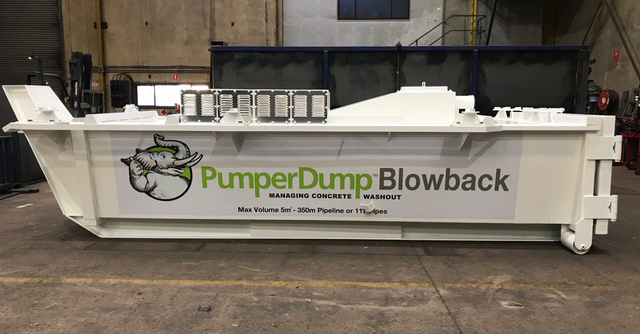
Introducing PumperDump’s New 5m3 Patent Pending Blowback Bin
Transforming industry experience, a wealth of knowledge and continuous system innovation for concrete pumping and concrete waste collection, PumperDump has been a player in the concrete pumping industry for years.

With the roaring success of the 2m3 (2 Cubic Meter) blowback bin which launched more than 10 years ago, it was not difficult to notice the gap in the market for something a little bigger. After months of planning and trialling, we are proud to introduce the new 5m3 (5 Cubic Meter) blowback bin to the streets of Sydney. 

Our latest innovation would not be possible without the collaboration of some important players in the industry.

We would like to thank Bincorp for the manufacturing of the bin, De Martin & Gasparini for assisting during the construction and for trialling the bin, and WATPAC for permitting this bin to be trialled on their site. We would also like to give thanks to Azzurri Concrete for their input during the construction.


This video shows the second blowback in the same bin without being emptied. PumperDump believes a modest improvement as such could save concrete pumping companies, builders and concrete suppliers money over the duration of a project.

How you ask?

While the delivery line is short and the bin is set in place, you will be able to get a couple of blowbacks into the same bin before it needs to be emptied. Depending on who is paying for the current blowback truck, this could reduce the blowback bill considerably. The bin is also ready at your disposal if there are any problems to occur during the pour – so no waiting for a blowback truck to arrive when time is crucial.

For builders, concreters or concrete suppliers who care about sustainability, there is far less truck movement, reducing the carbon usage associated with a blowout as well completely eliminating the use of plastic, strongly keeping to our policy of no plastic in any of the equipment or waste stream.

Lastly, for the concrete suppliers. There is no need to immediately cart concrete to your yard – reducing fuel consumption, turnaround time for the next load is much quicker, as well as reduced tipping or carting fees for the removal of waste concrete brought back to your yard.

So, depending on who you are in the industry there is a saving for you!

As this is a new system, we have a very limited number of 5m3 (5 Cubic Meter) bins. Nonetheless, we are more than happy to talk to any party interested in using a 5m3 on their current or new projects.
Share this article

A Sustainable Solution

Builders have been telling me that they need a sustainable solution to address the problem.

Sustainability

Sustainability is defined as the ability of a system to exist constantly at a cost, in a universe that evolves towards thermodynamic equilibrium, the state with maximum entropy. In the 21st century, it refers generally to the capacity for the biosphere and human civilisation to coexist. For many in the field, sustainability is defined through the following interconnected domains or pillars: environment, economic and social. 

Sustainability is not environmentalism and people in the construction industry are slowly recognising the difference.

The Venn diagram shows how sustainability intertwines different areas to achieve a better outcome. Sustainability is slowly becoming the way to do business as large funding organisations are requiring better accountability before finance is approved.


Adams, W.M. (2006). The Future of Sustainability: Re-thinking Environment and Development in the Twenty-first Century. Report of the IUCN Renowned Thinkers Meeting, 29–31 January 2006 (PDF). Retrieved 16 February2009.

The increasing focus and relevance of sustainability in the construction industry is more than just ‘being green’, sustainability encompasses, social, environment and economic, and I believe that “concrete pumping” as an industry, needs to be viewed in a new light as it has a major role in construction and the hidden costs and opportunities for a sustainable process should not be overlooked.

My next post, a solution proposed.

#ConcreteWaste #Construction #ClimateChange #Sustainability #PumperDump

Want to know more, then get in touch

Share this article

Aggravating the Process and Contributing to the Waste

I have tried not to make any comments in the past posts but, I was confused why the builder was even using the tray when all they would do is tip it into a pile on the ground. The pile of concrete is contaminated with plastic from the tray lining like the other methods mentioned in my previous posts.


The piling and removal of the concrete would mean double, even triple handling of this waste. This pile would only amount to a very small portion of the leftover concrete on this site. What a mess!

Concrete mixers have also poured their remaining concrete on the pile instead of returning it to the batching yard. This will save the builder money, but now the builder will need to organise a machine on site with a hammer to break up the concrete before it can be loaded and taken to a tip or recycler.

The mess left over is quite obvious. It may bother some builders and maybe not others, having a site with this amount of slurry left that could create a hazard, a cost and generally poor look.

My next post,  summary of the problems.

#ConcreteWaste #BadPractice #Sustainability #PumperDump

Want to know more, then get in touch

Share this article

Breaking the Rules and Breaking the Equipment

The photo and video will say the thousand words.

My last post talked about washout trays and the need for them to be emptied into the onsite skip.

With safety being a very important aspect of our lives on site, actions like this need to be taken seriously.

The video shows a washout tray being tipped into a skip. On a site with 100 + pours this constant abuse will eventually cause damage to the manitou. 


While I have been told of machines with cracks appearing on the boom or the rotator being damaged, the photo below shows damage to a manitou tyne from lifting overweight bins and constant banging. The new attachment sits in the distance. It was a $4k fix and this is on a tier 1 builder’s site!

You may or may not be surprised of how often this happening on your site.

#ConstructionRisk #EquipmentDamage #Manitou #PumperDump

Want to know more, then get in touch


Share this article

The Trouble with Concrete Washout Bags

Concrete washout bags are easy to use and are cheap to buy. They are lined with an inner plastic bag to stop the leaching of the washout water. They have tie ropes to keep the bag up while being filled.


Concrete pump operators keep them on their pumps in case of emergencies when builders haven’t thought of organising a washout area. They have a holding capacity of .5 of a cubic metre. When used on site, the builder needs a crane or forklift to lift as the bag would weigh around a tonne or more when full.

We used to sell the bags around 2 years ago but stopped because of the amount of plastic we were taking to the concrete recyclers and our decision not to use plastic in our operation.

Concrete recyclers were also explaining that it was very difficult to remove all the plastic from the concrete, contaminating the

recycled concrete, and the bags outside weaved material getting caught in the crusher causing them to shut down to untangle the material.

The builder’s problems arise when the pump needs more than a volume of .5m3 to wash out and the water ends up all over the surrounding area. This can create slip hazards when the slurry dries or if used on a roadway, as well as time and labour to clean up after the pump has gone. When the bag is picked up full and wet, the slurry often pours out of the bag, as it has no rigidity until the concrete has cured.

These bags are usually dumped into the onsite skip and add to hidden costs as the skip bin will quickly get to its weight limit without even utilising the skips volume capacity. The builders who are adopting a more sustainable future would possibly not use these bags on their sites.

Enjoy the photos.  The next post is on concrete washout trays.

Is this set up really going to work?

Overweight issues:

Need a bigger bag:

Future land fill; there is a better way:


Want to know more, then get in touch

Share this article